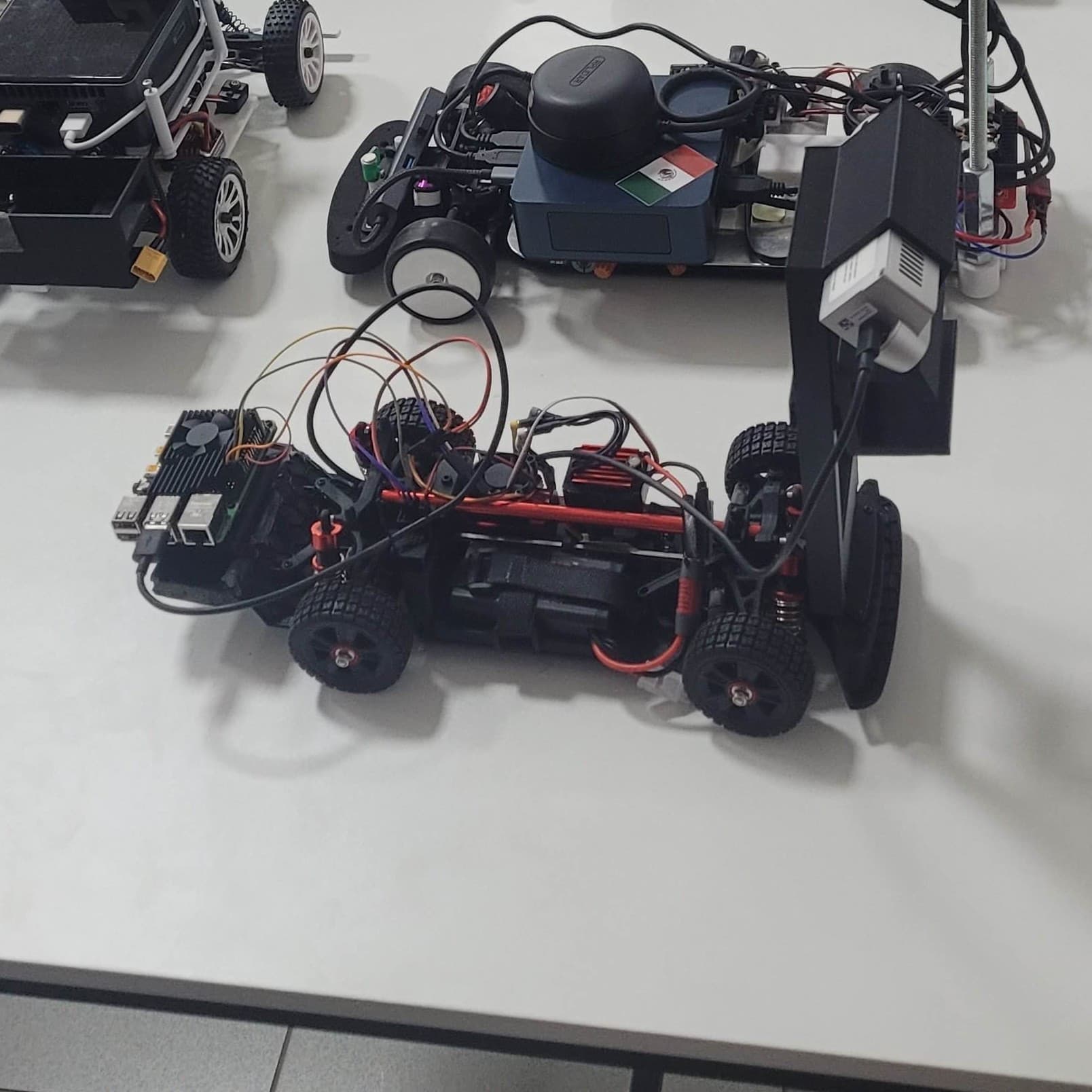
Overview
This autonomous race car was designed and built for the FIRA RoboWorld Cup as a two-person team project. A Raspberry Pi processed live video from a Logitech camera to identify the track, while an Arduino handled the vehicle's lower-level motor and steering interfaces.
The completed system combined perception, control, embedded programming, and physical track validation. It achieved first place at the national competition and second place internationally.
Control pipeline
- CaptureA forward-facing Logitech camera provides a continuous view of the race track.
- DetectPython and OpenCV process each frame and use edge information to locate the road lines.
- EstimateThe vision system calculates the car's position relative to the desired path.
- CorrectA PID controller converts path error into responsive steering adjustments.
- ValidateRepeated track testing informs control gains and improves consistency at race speed.
My engineering contribution
Working in a two-person team, I programmed the Raspberry Pi and Arduino systems in Python and C and integrated the Logitech camera used for real-time perception. The vehicle divided responsibilities between the two controllers: the Raspberry Pi handled image processing and high-level steering decisions, while the Arduino interfaced with lower-level motor and steering hardware.
My work focused on integrating the camera-based perception pipeline with embedded steering control. Detected road edges were converted into a path-error signal for the PID controller, while separating perception from actuation made the system easier to diagnose and tune on the physical track.
Testing and outcome
Making the system competition-ready required iterative physical testing. Camera placement, edge-detection behavior, steering response, and PID gains were adjusted through repeated track runs rather than evaluated only in software. This process required treating perception and control as one coupled system: changes to the detected path directly affected steering stability.
The resulting vehicle placed first at the national competition and second at the international FIRA RoboWorld Cup. The project strengthened my experience integrating software with physical hardware, diagnosing coupled failures, and refining control behavior through repeatable testing.