Overview
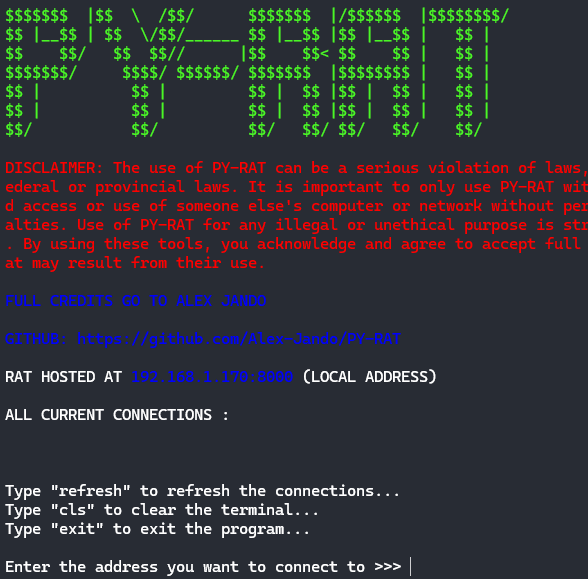
PY-RAT was an early solo Python networking project that paired an operator-side console with a Windows client. It used a custom TCP socket protocol to exchange commands, status information, files, and image data while exploring how remote-access capabilities interact with an endpoint.
The implementation also exposed the risks of building capability before safeguards. It did not provide authenticated identities, encrypted transport, least-privilege controls, user visibility, or audit logging, and it is not suitable for deployment. I present it here as a retrospective on the networking and packaging lessons it provided—and on the security requirements a responsible redesign would need from the outset.
System architecture
- ConnectThe Windows client establishes a TCP connection to the operator-side server.
- FrameA custom length-prefixed message format keeps commands and responses intact across the socket connection.
- DispatchThe client maps recognized messages to file, system, process, and media operations.
- ReturnResults and binary media are encoded and transmitted back to the console for display or storage.
- PackagePyInstaller bundles the client and required modules into a standalone Windows executable.
Implementation
I designed the length-prefixed message protocol, operator console, and Windows client. The console tracked connected clients and supported file transfer, system inspection, process operations, and media capture. OpenCV and NumPy handled screenshot, camera, and stream data, while separate threads isolated connection and streaming work from the primary console flow.
Packaging the client with PyInstaller created a standalone executable that could run without a separate Python installation. That exercise exposed practical deployment concerns such as bundling native dependencies, resolving runtime paths, and keeping client and server behavior synchronized as the command set evolved.
Security lessons
Building the prototype provided a practical view of the behaviors defenders must account for in remote-access software: persistent network communication, broad file-system access, command execution, and sensor capture. In retrospect, the absence of authentication, transport encryption, least privilege, explicit consent, and auditability is the project's most important design lesson.
A responsible redesign would begin with a threat model, mutual authentication, encrypted transport, narrowly scoped capabilities, visible user consent, immutable audit records, and an isolated test environment. The historical implementation is not presented or linked as production-ready software.