Overview
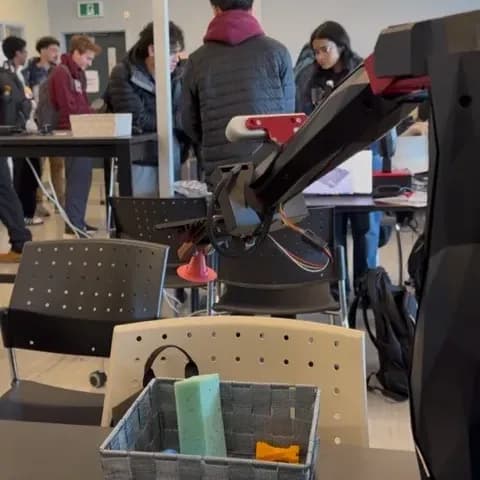
This team-based engineering project addressed a warehouse automation scenario: design an end effector and control system capable of using a Q-Arm robot to identify, pick, and pack products. The mechanism had to operate within limited motor torque, a 100 g mass allowance, and manufacturing constraints that restricted parts to 3D printing and laser cutting.
Our final system paired a custom mechanical gripper with modular Python software for product lookup, arm movement, packing operations, and tracking logs. I contributed across the mechanical and software workstreams, from the initial mechanism concept and first working CAD assembly to system integration and physical debugging.
Mechanical design
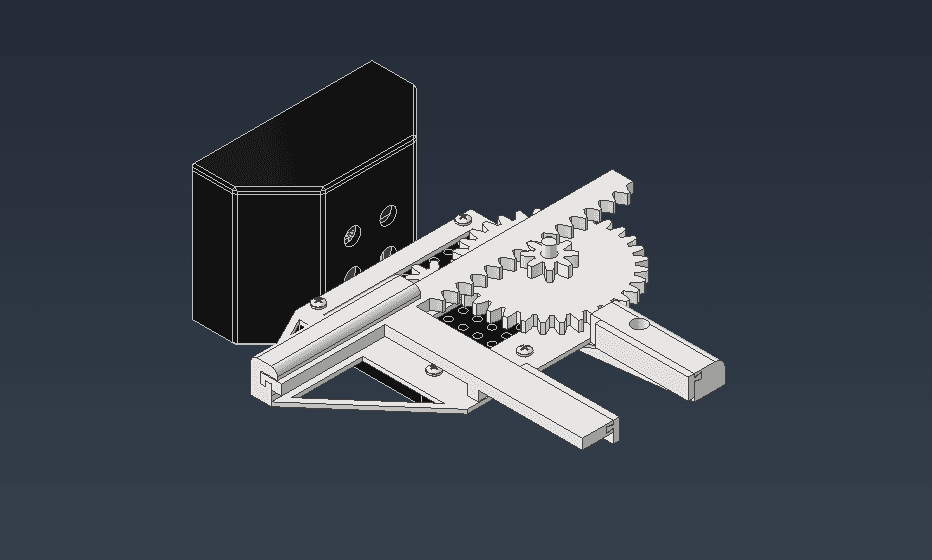
I proposed a two-finger gripper driven by a 4:1 gear reduction and linear rack-and-pinion mechanism. The gear train increased the clamping force available from the Q-Arm motor, while the opposed racks translated rotation into synchronized linear jaw motion. The design was intentionally compatible with additive manufacturing and compact enough to remain within the end-effector mass limit.
I created the initial sketches and the first fully functional Autodesk Inventor assembly. The team then iterated on that model through repeated print-and-test cycles, addressing gear meshing, friction, dimensional tolerances, and flex in the rack supports. When the original supports proved insufficiently rigid, I proposed expanding the supporting base geometry to improve mechanical reliability.
Control software and integration
The control program was divided into independently testable functions before full-system integration. I wrote the main orchestration logic, pack_products, and lookup_products, then rewrote and integrated the remaining modules into a single program. This structure allowed individual behaviours to be verified without repeatedly resetting and exercising the full robot.
Modularity became especially valuable during hardware integration. Arm positions, gripper behaviour, and order-handling logic could be calibrated separately, making it easier to distinguish mechanical issues from control-flow defects. The resulting program coordinated product selection, Q-Arm movement, packing, and operation records as one end-to-end workflow.
Validation and engineering lessons
Physical testing revealed failure modes that were not obvious in CAD. Printed parts introduced friction and dimensional variation, zero-clearance features did not assemble reliably, and thin supports flexed under load. Each issue required a measured redesign rather than assuming the digital model would translate directly into a working mechanism.
The completed prototype successfully used the Q-Arm and custom gripper to pick up and place the test objects. More importantly, the project established a repeatable engineering workflow: define constraints, model a mechanism, manufacture it, isolate failures through modular testing, and feed those results into the next design iteration.